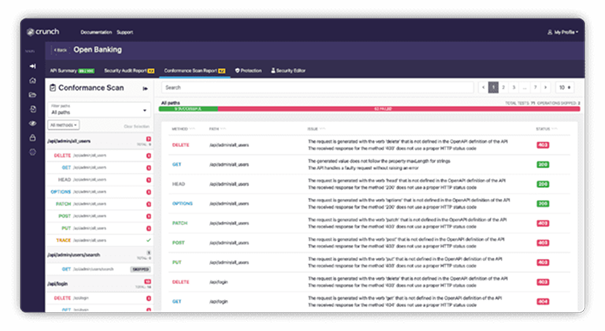

The #1 platform for automating API security testing and threat protection. Stop ongoing attacks on vulnerable production APIs. Automate remediation and the redeployment of all broken APIs to prevent future disruptions.
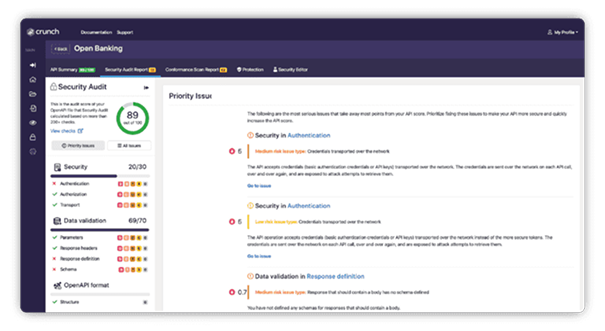
CI/CD 42Crunch API Audit
Empower your Continuous Integration and Continuous Development (CI/CD) pipeline by acting as a linter to perform an analysis of your OpenAPI (Swagger) files.
It performs a static analysis of each of the OpenAPI definition files, running over 300 checks that apply best practices and identify potential vulnerabilities.
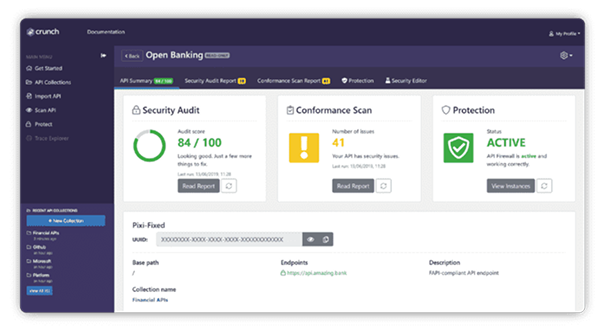
An automatically generated report identifies any issues, classified by severity, based on various criteria such as security, data validation, schemas, and specification format. It also offers advice on how to fix these issues.
OpenAPI Audit:
The editor also includes an additional integration with the 42Crunch audit tool or linter, API Audit, which detects security issues, data validation, and specification format directly from the editor. The audit runs within your favorite IDEs and generates a summary audit report in real-time within the same environment. These audit reports allow developers to work more efficiently by quickly identifying flaws, performing bulk fixes, and reducing security risks.
Security Ready
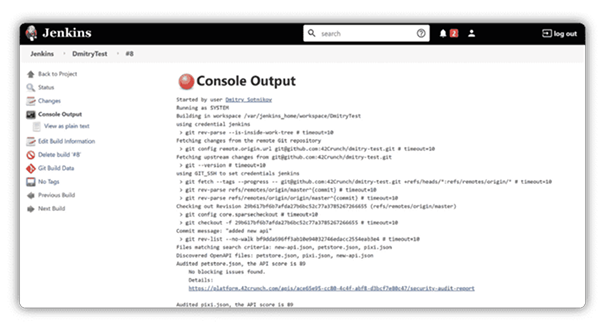
42Crunch ensures that all your APIs meet the necessary security standards before deployment. Perform a security audit of the OpenAPI contract, analyze live API endpoints for potential vulnerabilities, and automate the redeployment of runtime protection policies with every API change, thus ensuring agility and the implementation of a zero-trust architecture.
Our API Firewall's positive security model, where policies automatically adapt to each API. This virtually eliminates false positives and negatives, and does not require training AI for weeks to learn the model.
APIs Enabling Open Banking and Third-Party Integrations
APIs have been the primary engine of digital transformation in the financial sector, enabling seamless integration between banks and third-party applications to offer cutting-edge services such as mobile banking and Open Banking. However, this technological openness represents a critical security challenge; poorly protected interfaces can expose institutions to cyberattacks, fraud, and irreparable reputational damage, making API protection indispensable for maintaining customer trust and operational integrity.
Currently, the sector operates under a highly strict regulatory ecosystem that forces entities to balance innovation with data privacy. Regulations such as PSD2, GDPR, and PCI-DSS require banks to demonstrate robust security in their connections to avoid massive economic sanctions. Ultimately, API security is not just a technical defense measure, but a fundamental legal requirement to ensure regulatory compliance and the viability of financial services in the digital age.